-
+86-15690533330
- shuangyangjixie@mail.ru
-
China, Hebei Province, Tangshan City, Caofeidian District, SME Industrial Park, South Side of Zhi'er Road


+86-15690533330
China, Hebei Province, Tangshan City, Caofeidian District, SME Industrial Park, South Side of Zhi'er Road
2026-05-17
Why choose a hammer crusher rather than a jaw crusher or cone crusher?
Claw crushers are suitable for crushing ore rocks, cone crushers are more often used for processing iron ore, and hammer crushers are specially designed for organic materials and can process materials such as grain, feed, sawdust, food industry waste, etc. The operating principle of a hammer crusher is based on abrasive impact crushing, as opposed to crushing by pressing and crushing.
The hammers rotate at a high linear speed of 35–45 m/s, repeatedly striking the material and simultaneously throwing it onto the sieve. The particle size of the material is not controlled by the mechanical gap, but is controlled by the effective screen area and the rotor speed. This type of crusher has three key advantages:
Constant fineness of crushing: even with fluctuations in the humidity and density of the source material, the particle size of the output product remains uniform;
High resistance to contamination: metal impurities and stones up to 8 mm in size that get into the material do not lead to equipment breakdowns;
Low wear of wearing parts: The hammers can rotate around the axis, which ensures uniform wear and effectively increases the service life.
Taking into account actual working conditions: if granulated feed PK - 1 or compound feed based on barley and soybean pulp is processed on the production line, the yield of a suitable product on a hammer crusher typeSFSP - 66can reach 94.7%, and the specific energy consumption is 13.3 kWh/t. These data were confirmed at a special testing facility in Tangshan.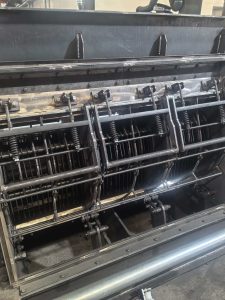
Common causes of losses due to equipment wear and ways to eliminate them
Based on a large number of practical examples, we have identified three common mistakes when choosing and using equipment:
Consider only engine power, ignoring actual performance at a given particle size
A 110 kW hammer crusher can have a capacity of 8 tons per hour when crushing to a particle size of 1.2 mm, but if the particle size is required to be reduced to 0.6 mm, the productivity drops sharply to 4.5 tons per hour. The engine power rating is not the relevant figure, but the performance table is what is important. The technical manual for each SFSP series model contains this information in detail.
Do not take into account the operating temperature of the equipment
When crushing hot granular materials at temperatures above 65°C, standard hammers reduce their hardness. Solution: use of 65G steel with a hardness after hardening of 52–55 Rockwell and enhanced cooling of the housing. These settings can be customized upon request.
Lack of dust collection system at the entrance
Dust in the supply line is the main cause of bearing failure. Installing a round impulse vacuum cleaner in front of the crusher can reduce equipment downtime for maintenance by 40%.
Frequently asked customer question: Can one piece of equipment handle both grain and grass debris?
Yes, but it is necessary to replace the sieve and adjust the rotation speed: for processing grain, the speed is set to 2900 rpm, for processing grass debris - 2200 rpm. The standard equipment includes a built-in frequency converter with two pre-stored sets of operating parameters, which makes it easy to switch between modes.
The secret to crusher durability
The reliability of the equipment is not a marketing ploy, but is based on six-step engineering developments. All solutions have been tested at the production site in Tangshan:
The rotor is made of a solid 40X alloy gear shaft, balanced to class G2.5 (meets ISO 90001);
The hammers are secured with double clamps on the axle, which prevents them from being torn off when the equipment vibrates;
The body is made of 16mm thick St3 steel plate, the impact zones are reinforced;
The bearing assembly uses SKF products, IP65 protection level, with direct access to the lubrication system, which facilitates maintenance;
Before being sent to the market, each device undergoes a 4-hour start-up test and a 2-hour load test with monitoring of vibration, temperature and noise indicators;
All seams are 100% ultrasonic tested and an inspection report is supplied with the equipment.
Our equipment is not an ordinary contracting product. From the procurement of steel to the final inspection of the finished machine, the entire process is strictly controlled. Service life: when working in feed processing, the average service life of the rotor is 12,000 hours, and the hammers - 6,500 hours.
Hammer crusher is your ideal choice
When building a new production line or upgrading existing equipment, it is necessary to first carry out an accurate calculation of the operating conditions.
The following parameters must be provided: type of source material, humidity, initial particle size of the material, target particle size of the output product, required productivity, presence of a dust collection system.
Based on this data we can select a modelSFSP - 60orSFSP - 66, calculate energy consumption, select the optimal configuration and provide drawings for installing equipment on the production line.
A complete set of documentation is provided in Russian, along with a declaration of conformity of the Eurasian Economic Union and a certificate of compliance with Russian state standards.
Our service includes a full range of services: assistance with customs clearance, installation and configuration of equipment on site or remote video support. We offer not just a piece of equipment, but a comprehensive solution for long-term and stable operation. Today, in a year, in five years it will remain reliable.


![Efficient Feed Hammer Crusher In Stock | [Shuangyang Feed Making Equipment]](https://ecdn.cnyandex.com/jlgo93c/uploads/养鸡场自建饲料厂.png)